Showing posts with label Books. Show all posts

Monday, 26 February 2018

Reading about Raleigh in Budleigh (3): Fairlynch Museum’s Carter Library

Continued from https://raleigh400.blogspot.co.uk/2018/01/reading-about-raleigh-in-budleigh-2.html


With its Sir Walter Ralegh Room, and with a significant number of Ralegh enthusiasts among its volunteers over the last 50 years, it’s not surprising to find a fair number of books about the great Elizabethan in Fairlynch Museum. Here are the titles that I found in a recent exploration:  


Christopher M. Armitage – Sir Walter Ralegh: an Annotated Bibliography   

Published for America's Four Hundredth Anniversary Committee by the University of North Carolina Press, 1987 pp.236  

This is described as an exhaustive work citing approximately 2000 items, including biographies and other writings about Ralegh. It encompasses all works written by or attributed to Ralegh. 


Professor Armitage joined the UNC-Chapel Hill faculty in 1967, specializing in seventeenth- and twentieth-century English and Canadian literature. After graduating from Oxford University he earned a second master’s degree from the University of Western Ontario in Canada in 1964, and a doctorate from Duke University in 1967. Since 1970 he has returned annually to England to conduct a six-week study program on ‘Shakespeare in Performance’  for students and alumni. 

His Literary and visual Ralegh was published by Manchester University Press in 2013. You can read an entertaining interview about Raleigh with Christopher Armitage at https://www.indyweek.com/indyweek/sir-walter-lived-large-and-traveled-well-but-never-to-the-new-world/Content?oid=3624054


Roger Bowen – From Lunacy to Croquet: The Life and Times of Dr Thomas Nadauld Brushfield  2013.  From the publisher’s description: ‘The story of Dr Thomas Nadauld Brushfield (1828 - 1919) richly deserves to be told. He was one of those very rare people who truly deserve the epithet polymath. As a pioneer in the treatment of lunacy he had few equals; as a bibiophile he was celebrated for his studies into the life and literary works of Sir Walter Ralegh’.  To read about the great Ralegh scholar and Budleigh resident Thomas Nadauld Brushfield click on https://raleigh400.blogspot.co.uk/2017/12/dr-thomas-nadauld-brushfield-md-fsa.html


T.N. Brushfield MD  - Raleghana  Reprinted from the Transactions of the Devonshire Association for the Advancement of Science, Literature and Art  1896-1910  To read about the great Ralegh scholar and Budleigh resident Thomas Nadauld Brushfield click on https://raleigh400.blogspot.co.uk/2017/12/dr-thomas-nadauld-brushfield-md-fsa.html


Margaret Irwin  That Great Lucifer – A Portrait of Sir Walter Ralegh   Chatto & Windus 1960  pp.320
Oxford University-educated Margaret Irwin (1889-1967) was an English historical novelist whose novels were esteemed for the accuracy of their historical research, and she became a noted authority on the Elizabethan and early Stuart era, finally producing this biography of Raleigh.  She wrote a total of 16 novels including three set in the reign of Elizabeth I.  One of them, Young Bess about Elizabeth’s early years, was made into a movie starring Jean Simmons.


Robert Lacey  Sir Walter Ralegh  Weidenfeld & Nicholson 1973 pp.415
Robert Lacey, a former magazine editor and journalist, is the author of many best-selling works of biography and history.  His book, described as ‘an insightful study - the first based on an accurate chronology of Ralegh's own writings’ which ‘offers startling disclosures about his other love affairs, an illegitimate child, and a failed suicide attempt’.


Agnes Latham, (ed)  The Poems of Sir Walter Ralegh, edited by Agnes Latham. The Muses Library, Routledge & Kegan Paul, 1951. pp.182
Contains an introduction and critical comments.  From the publisher’s description:
‘This volume is an attempt to collect all the poems which can reasonably be attributed to Ralegh. Some of them have not appeared in any such collection before. The autograph manuscript of Cynthia, preserved at Hatfield House, is printed with Ralegh’s own spelling, preserving something of his west-country speech. The poems are arranged in an approximation to chronological order, each furnished with a list of the known sources and a statement with regard to authenticity. There are also notes upon poems doubtfully ascribed to Ralegh and rejected by his present editor; a bibliography of earlier editions; passages of critical comment by contemporaries; and three portraits, one of them a little-known miniature from Vienna, representing Ralegh as a young man, at the age at which much of his poetry must originally have been composed.’   


Agnes Latham and Joyce Youings (eds) – The Letters of Sir Walter Ralegh, University of Exeter Press 1999. pp.403.  
From the publisher’s description: ‘This edition of the letters of Sir Walter Ralegh will replace the long out-of-print edition of Edward Edwards published in 1868. It contains the full text, in the original spelling, with modern punctuation, of all known surviving letters, 240 in all, compared with Edwards' 160, in most cases taken from the original manuscripts, many never before published. All are extensively annotated, many have been newly dated and corrected; there is a substantial Introduction by Joyce Youings. The letters help to reconcile the family man, never happier than when at home on his estate in the West Country, with one who is revered, especially in North America, as the founder and inspirer of English overseas settlement. They show him drawn both towards his native West Country, where he was not universally admired, and towards the Court at Westminster where lay the determination of the success or failure of his enterprises. Never before have we been able to get as near to understanding the strengths and weaknesses of one of the best-known figures of English history, the man who was both patriot and European; courtier and failed politician; soldier and poet; owner of ships and organiser of privateering ventures yet a reluctant sailor; greedy for personal wealth and social status but apparently ready to plead the case of the poor and disadvantaged.’

Agnes Latham (1905-1996) was Professor of English at Bedford College, University of London. Three years after graduating with a First Class degree in English Language and Literature from Somerville College, Oxford, she published in 1929 what was still described at the time of her death  the definitive edition of the poems of Sir Walter Ralegh. Her research was completed on a one-year grant from the corporation of Wakefield, and she immediately embarked on what was to prove her lifetime's project of editing Ralegh's letters, a challenge which won her international recognition.

For Joyce Youings, see below.


John Guille Millais (ed) – The Life and Letters of Sir John Everett Millais, President of the Royal Academy, 2 vols, Methuen & Co 1899. Available online because, as one reads, ‘This work has been selected by scholars as being culturally important, and is part of the knowledge base of civilization as we know it.’  


Photo of Millais published in this work

So you can either click here https://archive.org/details/lifelettersofsir01milliala  or consult the fine edition in Fairlynch Museum’s Carter Library. According to the Oxford Dictionary of National Biography it ‘remains the fullest source of information on Millais’.  Millais’ painting ‘The Boyhood of Raleigh’ is featured.


Giles Milton  Big Chief Elizabeth: How England's Adventurers Gambled and Won the New World, Hodder & Stoughton, 2000. 416 pp.  
Giles Milton is a writer who specialises in narrative history. His books have been published in twenty languages worldwide and are international best-sellers. He has written nine works of non-fiction, a thriller, two comic novels and three books for young children. Big Chief Elizabeth relates the early attempts by Elizabethan adventurers to colonise the North American continent; the book takes its title from the Algonquian Indian word 'weroanza', used by the indigenous population in reference to Queen Elizabeth I. It focuses on the pioneering expedition of 1585 to colonise Roanoke Island in what is now North Carolina – an expedition that was financed and backed by Raleigh. The historical reconstruction of the attempted settlement makes extensive use of eyewitness accounts written by those who occupied senior positions in Raleigh's expedition – notably Sir Richard Grenville, Ralph Lane, John White (colonist and artist) and Thomas Harriot, and details the hardships faced by the colonists as they struggled to survive an increasingly hostile environment. It also seeks to explain the enduring mystery of the lost colonists – 115 men, women and children left behind on Roanoke Island when John White returned to England for help.


Lilian Sheppard – Raleigh’s birthplace: The story of East Budleigh
Granary Press, 1983 84 pp
Local writer Lilian Sheppard described her book as ‘Historical Jottings of East Budleigh, Bicton, Salterton, Otterton and Withycombe’. It’s a useful chronicle of local places, buildings and people, written with the thought that the author is describing ‘scenes beloved of young Raleigh’. Here, as she writes in a Preface, ‘the first sixteen years of his life were spent wandering these lanes and fields and the wide, unspoiled beach at Salterton, where the Cliffs and grassy paths reached down to the water’s edge. Here, under his fascinated gaze, the laden ships made their way into the Otter-mouth to make harbor in Budleigh Haven. Thus, perhaps, the seeds of that indomitable spirit of adventure which came to rule his life, were sown irrevocably in that young heart.’
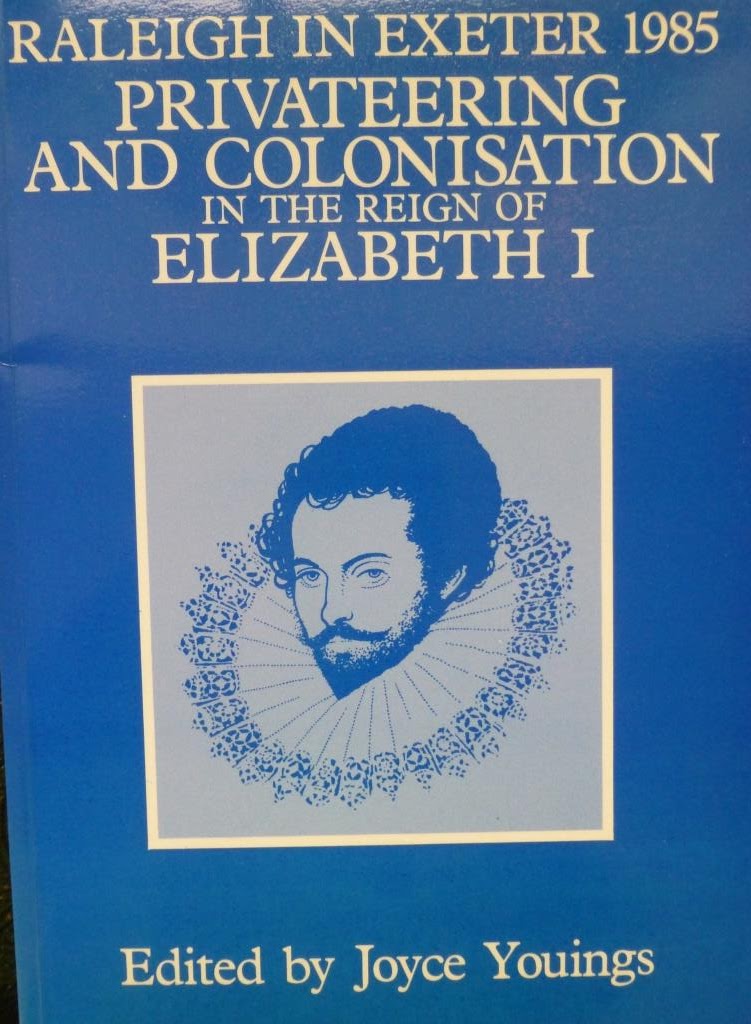


Joyce Youings (ed) Raleigh in Exeter - privateering and colonisation in the reign of Elizabeth I : papers delivered at a conference at Exeter University on 3-4 May 1985 to mark the four hundredth anniversary of the first attempt to settle English people in North America,  University of Exeter, 1985. pp. 117
Contents include Elizabethan Privateering, The three-masted ship and Atlantic voyages, Did Raleigh’s England need colonies, The Lost Colonists, The Americanization of Raleigh, The Raleighs, Father and Son, and John White and his drawings of Raleigh’s Virginia.


Joyce Youings Ralegh’s Country – The South West of England in the Reign of Queen Elizabeth I  North Carolina Department of Cultural Resources  1986. Pp.74  Described as ‘a detailed demographic, economic, political, and social study of the English counties of Devon and Cornwall’.

Devon-born Joyce Youings (1922-2011) was Emeritus Professor of English Social History at the University of Exeter. Originally intent on reading mathematics at King’s College, London, she changed her mind, reading history and then completing a PhD in Tudor studies at University College, London.  In 1951 – as a Tudor specialist – she joined the Department of History at the University College of the South West, encouraging local history studies across Devon. In 1965 the College became the University of Exeter. She is regarded as an outstanding historian of 16th century Devon producing a substantial body of publications over a wide range, including the disposal of monastic property, the cloth industry, municipal charters, the Western rebellions of 1549, Tudor maritime affairs and in particular early English colonial development in North America. Her work culminated in the meticulous collected edition of Raleigh’s letters.


FOR THE RALEIGH 400  CALENDAR OF 
EVENTS WORLDWIDE
IN 2018 CLICK ON 
http://raleigh400.blogspot.co.uk/2018/01/raleigh-400-calendar-of-events-in-2018.html


Wednesday, 31 January 2018

Reading about Raleigh in Budleigh (2)


Following on from my previous post about Raleigh-related books on the shelves of Budleigh Salterton Library I made a return visit a few days later, to be told by librarian Jane Cordy that there were further books that I might like to list. These are kept in a cupboard, and may be for consultation only because they are out of print and quite rare.

T.N. Brushfield – A Bibliography of Sir Walter Ralegh Knt  James G. Commin  Exeter, 1908  181 pp. Second edition.

You can read all about the great Ralegh scholar Dr Brushfield at http://raleigh400.blogspot.co.uk/2017/12/dr-thomas-nadauld-brushfield-md-fsa.html


Edward Edwards - The Life of Sir Walter Ralegh  2 vols
724 pp; 530 pp  Macmillan & Co 1868

This book is a real treasure. Google Books tells me that the work ‘has been selected by scholars as being culturally important, and is part of the knowledge base of civilization as we know it.’ So it can be read online. 

For Budleigh it’s especially important because it was published just before Millais came to the town to paint his celebrated ‘Boyhood of Raleigh’ and may well have been one of the reasons why he chose the subject of young Walter on the beach with his half-brother Humphrey Gilbert. Apart from that, the book was notable for publishing Raleigh’s letters, being based on contemporary documents preserved in the Rolls House, the Privy Council Office, Hatfield House, the British Museum, and other manuscript repositories. 

The story of its author has a rather sad ending. He is described on Wikipedia as the son of a builder, born in 1812, into a not especially privileged background. He was an important figure in the establishment of free libraries in the United Kingdom, but seems to have upset people with his impatient temper.  In his final years on the Isle of Wight, in Niton, where he had settled in retirement, we are told that he lived in poverty, on the charity of Rev John Harrison, a Baptist minister. In November 1885, he was found in a state of hypothermia on the nearby downs, and caught pneumonia. He died at Niton, on 10 February 1886, and is buried in the graveyard of the local Church of England church.


Walter Scutt – A short account of East Budleigh & Hayes Barton, birthplace of Sir Walter Ralegh  Printed at Cranford by the author  1936  63 pp

Walter Scutt was trained as an artist, and after his career as Chief Examiner of Schools under the Board of Education was cut short because of ill health, he settled in Budleigh Salterton in the late 1920s. 


He wrote three books on subjects of local history including the above title, which he illustrated with his own wood engravings, and printed by hand on his own small printing press.  The others are Otterton, a village of East Devon (1935), in an edition of 75 copies and Pride of Devon (1938), in an edition of 36 copies.  


A.T. Thomson (Mrs) – Memoirs of the Life of Sir Walter Ralegh, with some account of the period in which he lived  Longman, Rees, Orme, Brown and Green  1830 496 pp


‘This is a good book and worthy of recommendation,’ stated a review in Fraser’s Magazine for Town and Country, Volume 5 (1832). ‘Mrs. Thomson set a high task for herself, and she has accomplished it with zeal and ability. There is an occasional tendency to indulge in conjecture when authorities are defective, and a fondness for lingering over trifling incidents, and giving them the importance of main incidents: but the book is a valuable production.’ 

From Wonderful Wikipedia I learnt that the author was Katherine Thomson (1797–1862), an English writer, known as a novelist and historian who wrote as Mrs A. T. Thomson, and also used the pseudonym Grace Wharton.  She was the seventh daughter of Thomas Byerley of Etruria, Staffordshire, a nephew by marriage and sometime partner and manager of the pottery works of Josiah Wedgwood. She married, in 1820, the physician Anthony Todd Thomson, as his second wife. During their residence in London, for some of the time at Hinde Street, Marylebone, she and her husband assembled an artistic and literary circle, among their earlier friends being the poet Thomas Campbell and the artist David Wilkie (artist). Later, in Welbeck Street, they saw much of Thackeray, Robert Browning, and also of Lord Lytton, who became a close friend. Mrs Thomson was the author of many other works, including novels, biographies and histories such as Memoirs of the Court of Henry the Eighth.  


Continued at http://raleigh400.blogspot.co.uk/2018/02/reading-about-raleigh-in-budleigh-3.html


FOR THE RALEIGH 400  CALENDAR OF 
EVENTS WORLDWIDE
IN 2018 CLICK ON 
http://raleigh400.blogspot.co.uk/2018/01/raleigh-400-calendar-of-events-in-2018.html

Tuesday, 30 January 2018

Reading about Raleigh in Budleigh (1)


The West Country’s rich history is reflected in the number of books about local heritage that you find in its public libraries.  Budleigh Salterton Library on Station Road is no exception. In the 400th year of Sir Walter’s death it’s good to see that there’s a fair number of titles on the shelf, which now carries a helpful poster as well as the following.

Not surprisingly, Raleigh’s tumultuous life has inspired a fair bit of fiction, so novels are included as well as history studies.


Anna Beer - Bess: The Life of Lady Ralegh, Wife to Sir Walter
Constable  2004  287 pp

Anna Beer’s book, it’s been said, aimed to show that Bess was ‘the hidden force behind Sir Walter Ralegh's spectacular public achievements, the stable point in his turbulent private life and the shrewd creator of his reputation after his death’. The result is ‘a perceptive and immensely enjoyable biography’. 

One review complained that the book ‘is seriously flawed by what appears to be a personal bitterness’ on the part of the author, suggesting that for Raleigh she has ‘little but scorn’. I am not finding that to be the case.  

Anna Beer’s particular interests as a biographer are ‘the relationship between literature, politics and history’ which she has explored in her 2008 life of John Milton and  her 2016 study of the lives and work of female composers, Sounds and Sweet Airs: the forgotten women of classical music. She was Lecturer in Literature at the Department for Continuing Education at the University of Oxford between 2003 and 2010, and remains a Fellow of Kellogg College.


Richard Dale – Who killed Sir Walter Ralegh?  
The History Press, 2011. 192 pp

The author is a professor emeritus of the University of Southampton and a visiting professor at the University of Reading. A barrister with a PhD in law and economics, he has worked at N. M. Rothschild, the Rockefeller Foundation, and the Bank of England and written for the Financial Times. He is the author of Napoleon is Dead. ‘This is not only a thoughtful and precisely written work, but also an adventure story that sweeps the reader into another world,’ Elisabeth Stevenson in The Law Society Gazette.


Eric Delderfield – The Raleigh Country Raleigh Press 1985 edn, first publ 1949 158 pp

This book was written as ‘a brief history of Exmouth, East Budleigh, Otterton, Bicton, Budleigh Salterton, Sidmouth, Topsham and Lympstone, with ‘a short life story of that great Englishman, Sir Walter Raleigh’. 

Eric Raymond Delderfield was well known for his writings about West Country topics.  He moved with his family to Devon in 1923, when his father, William James Delderfield, became editor of the Exmouth Chronicle.  His brother Ronald became a well-known novelist.  Eric published over sixty books and guides, plus a series of Brief Guides, condensed versions of his books ranging from regionals to churches and inn signs.  He knew Exmoor and Devonshire well but also wrote about Yorkshire, the Lake District and the Cotswolds.


George Garrett – Death of the Fox: a novel about Raleigh  Barrie & Jenkins 1971 739 pp Described as ‘a meticulous re-creation’ of Elizabethan and Stuart England, the novel forms a trilogy with The Succession and Entered from the Sun. Here the author delves into the story of Sir Walter Raleigh's fall from favour for alleged conspiracy against James I, transporting the reader, in one words of one review, to ‘a world of cunning, intrigue, and colorful abundance’. 

George Palmer Garrett (1929-2008) was an American poet and novelist. He was the Poet Laureate of Virginia from 2002 to 2004. His other novels include The Finished Man and Double Vision. He worked as a book reviewer and screenwriter, and taught at Cambridge University and, for many years, at the University of Virginia.


Stephen J. Greenblatt – Sir Walter Raleigh: The Renaissance Man and his Roles.  New Haven, CT Yale University Press 1973  209 pp

Based on the author’s doctoral thesis, the book is described by an American reviewer as ‘seeking to explore the ways in which Raleigh attempted “to fashion his own identity as a work of art”’. 

Greenblatt, in the review’s words, ‘focuses on the contradictions within Raleigh’s life, his complex relation to the world he inhabited, and the inadequacy of the distinction between life and art in thinking about Raleigh’s life’.  

Stephen Jay Greenblatt is a Pulitzer Prize winning American literary critic, theorist and scholar. He is Cogan University Professor of English and American Literature and Language at Harvard University. He is the author of many books, including Will in the World: How Shakespeare Became Shakespeare, Hamlet in Purgatory, Practicing New Historicism and Marvelous Possessions: The Wonder of the New World. He is a fellow of the American Academy of Arts and Sciences and the American Philosophical Society. He lives in Cambridge, Massachusetts, and in Vermont.


Shaun McCarthy – Sir Walter Raleigh Heinemann Library 2002 48 pp

The book is described as presenting an account of Raleigh's life and explorations, and examines their impact on history and the world. 

Author Shaun McCarthy has written books on a variety of subjects, many of them forming part of a series published for primary school children and students. On a similar subject was his book about James Cook, exploring how he got his start as a sailor and why he was chosen to lead an expansion to the South Pacific. Shaun McCarthy has also written study notes for students, including exam-focused analyses of texts ranging from the poems of Seamus Heaney to Arthur Miller's play The Crucible.


Lilian Sheppard – Raleigh’s birthplace: The story of East Budleigh Granary Press, 1983 84 pp

Local writer Lilian Sheppard described her book as ‘Historical Jottings of East Budleigh, Bicton, Salterton, Otterton and Withycombe’. It’s a useful chronicle of local places, buildings and people, written with the thought that the author is describing ‘scenes beloved of young Raleigh’. Here, as she writes in a Preface, ‘the first sixteen years of his life were spent wandering these lanes and fields and the wide, unspoiled beach at Salterton, where the Cliffs and grassy paths reached down to the water’s edge. Here, under his fascinated gaze, the laden ships made their way into the Otter-mouth to make harbor in Budleigh Haven. Thus, perhaps, the seeds of that indomitable spirit of adventure which came to rule his life, were sown irrevocably in that young heart.’


Andrew Sinclair – Sir Walter Raleigh and the Age of Discovery 
Penguin Books, 1984  128 pp

This book was published to coincide with the launching of Operation Raleigh, after which two renovated ships - Sir Walter Raleigh and Zebu - carried 4,000 volunteers and almost 1,600 staff to take part in expeditions around the world until 1988. 

So I find it very odd that there is no mention of Sir Walter on Raleigh International’s website at https://raleighinternational.org Its Patron, Sir Ralnulph Fiennes, was unable to give me any explanation for this. 

The book, according to a description, ‘traces the life and accomplishments of the sixteenth-century British explorer, examines his relationship with Queen Elizabeth I, and attempts to portray his complex personality’. Eton-educated Andrew Sinclair, born in 1935, is an amazingly prolific author, described as a historian, novelist, critic, filmmaker, editor and translator, and a founding member of Churchill College, Cambridge.


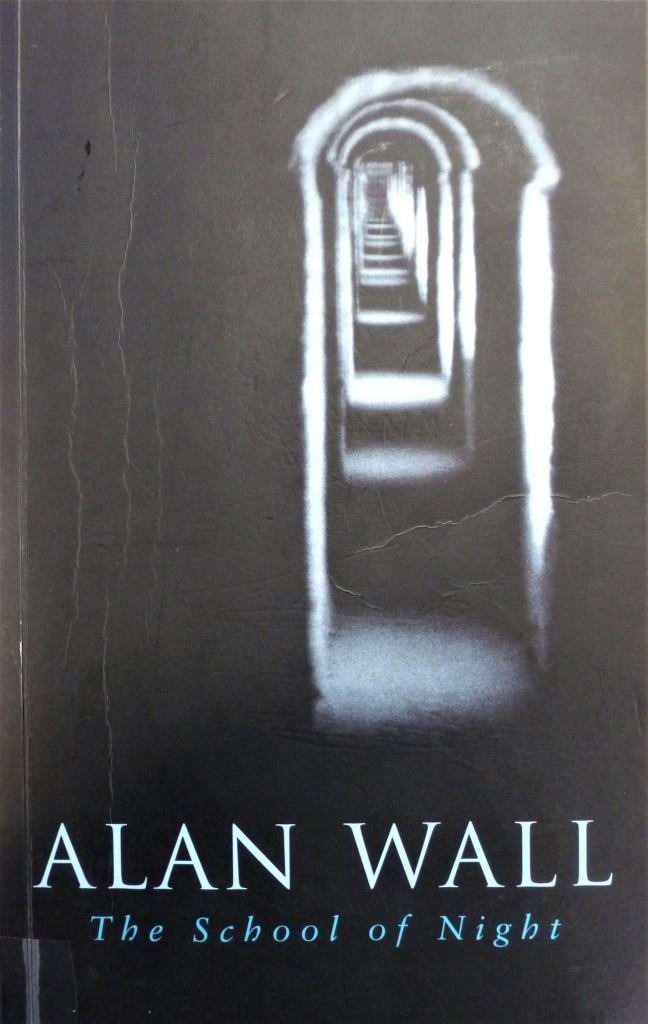
Alan Wall – The School of Night  St Martin’s  Secker & Warburg 2001  304 pp Described as ‘part scholarly mystery, part thriller, the plot of this novel opens when its narrator, BBC editor Sean Tallow, steals two Elizabethan-era tomes from a university library. In the ‘Hariot Notebooks’, as they are called, written by Sir Walter’s friend Thomas Hariot, he hopes to find reference to the enigmatic School of Night, a group of Elizabethans which possibly included the writer George Chapman and its reputed leader Sir Walter Raleigh. 

Yorkshire-born Alan Wall studied English at Pembroke College, Oxford and is Professor of Writing and Literature at the University of Chester. His other novels include Bless the Thief and The Lightning Cage. 

More about Budleigh Salterton Library at 
www.facebook.com/BudleighSaltertonLibrary 


FOR THE RALEIGH 400  CALENDAR OF 
EVENTS WORLDWIDE
IN 2018 CLICK ON 
http://raleigh400.blogspot.co.uk/2018/01/raleigh-400-calendar-of-events-in-2018.html


Raleigh the Peacemaker (1586)

  A copy, in All Saints' Church East Budleigh, of one of the best known portraits of Sir Walter formerly attributed to Zuccaro but now...