Showing posts with label Virginia. Show all posts

Wednesday, 14 November 2018

The watercolours of John White: artist and explorer


Detail from the title page of 'Thomas Hariot’s A Briefe and True Report' of the New Found Land of Virginia, published in 1590   

All John White images © The British Museum

A talk about Sir Walter Raleigh – and I did quite a few in 2018 – covers so many aspects! One that’s always interesting for audiences because of the visual element – as opposed to the talking – is the amazing collection of watercolours by John White, one of the treasures of the British Museum. 
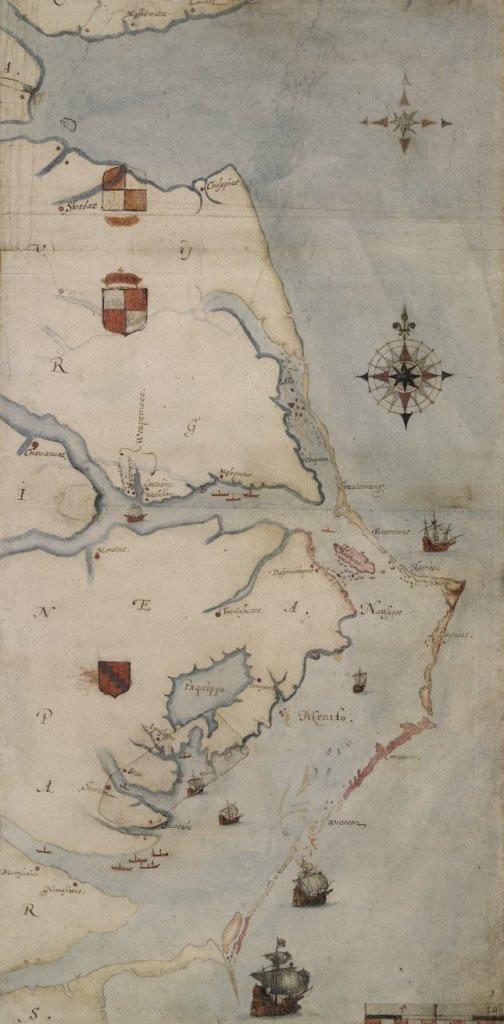
    

 The paintings are a record of White’s time as an artist and mapmaker on the 1585 expedition to Roanoke Island, on the east coast of North America, funded by Sir Walter Raleigh.

Also accompanying the expedition was Raleigh’s friend and tutor, the scientist Thomas Harriot.  

His account of the voyage, named 'A Briefe and True Report of the New Found Land of Virginia', was published in 1588, probably written a year before.


Above: Virginea Pars map, drawn by John White during his initial visit in 1585. Roanoke is the small pink island in the middle right of the map.


White’s images were used by the publisher Theodor de Bry in a new, illustrated 1590 edition of 'A Briefe and True Report of the New Found Land of Virginia'. They added to an already intense interest in the New World. 

The only surviving visual record of the land and peoples encountered by England’s first settlers in America, the paintings are rarely on display, needing to be kept away from the damaging effects of light. A major public of the images took them to the USA in 2008.


The British Museum had no plans to exhibit them for Raleigh’s 400th anniversary.


A watercolour by John White depicting a village of the Secotan Indians in North Carolina 

‘Come to this place where everything is neat and tidy and there is food everywhere!’ is the message of John White’s watercolours according to the American author and science historian Deborah Harkness.


'The towne of Pomeiock and true forme of their houses, covered and enclosed some wth matts, and some wth barcks of trees'


'The manner of their fishing'


'You won't starve' in the New World' is the message that  Raleigh was keen for readers to understand.


'The seething [boiling] of their meate in Potts of earth' 


Equipment for curing fish used by the North Carolina Algonquins 


Dancing Secotan Indians on Roanoke Island


A ceremony of Secotan warriors


An Algonquian chief 


A 'flyer' or medicine man


Apart from his achievement as a an artist, John White is known as the grandfather of Virginia Dare, the first English-speaking child to be born in the New World.   Tragically, he never saw his granddaughter, who was one of the 115 settlers known as 'The Lost Colony' 


Governor John White and his men discover in 1590 the word CROATOAN carved on a tree - the only trace of the 1587 ‘Lost Colony’ of 115 settlers which included White's granddaughter (19th century illustration)

The later history of the relationship between Native Americans and the English is an unhappy one, full of sad episodes of mistrust, betrayal, violence and murders in which two of Raleigh’s commanders, Sir Richard Grenville and Sir Ralph Lane, played critical roles.

John White was different, wrote David Stick in his book 'Roanoke Island: The Beginnings of English America'(1983). He was ‘without question, a compassionate man, and, unlike Lane, an individual with a reverence for all God’s earthly creations, including even the natives of America, whom he had depicted in his drawings as people both gentle and proud.’


Historian Anna Beer, while writing of what she described as ‘the dark underbelly of the English colonial project’, cites John White’s drawings and Thomas Harriot’s study of the Algonquin language as supporting the view of those who argue that Raleigh ‘respected the culture and people he was intruding on, and sought to understand it and them’.

Had Raleigh himself led the 1585 Roanoke expedition rather than Grenville and Lane, things might have taken a happier turn. But that’s wishful thinking. Queen Elizabeth kept her favourite at court. And however ‘soft’ Raleigh’s imperialism may have been, English culture would end up by first transforming and then obliterating the culture of Native America as Dr Beer points out.

Yet John White’s drawings can stand on their own, be admired, and allow us to dream of how it might have been.


FOR THE RALEIGH 400  CALENDAR OF 
   EVENTS WORLDWIDE
IN 2018 CLICK ON 


Friday, 2 November 2018

Sir Walter Raleigh beyond England: A Symposium, 29 October 2018, at St Margaret's, Westminster


Above: Fort Raleigh, Roanoke Island, North Carolina 
An illustration of how the Fort might have appeared, published by the National Park Service 

Dr Eric Klingelhofer and Dr Bly Straube were the two distinguished speakers who presented insights into the latest findings at archaeological sites associated with Raleigh's colonial settlements in both Ireland and North America. 


Image credit: Mercer University

Dr Klingelhofer is a retired professor of history at Mercer University in Macon,Georgia. 

Discoveries of colonial settlements in Virginia and North Carolina owe much to the efforts of people like J.C. Harrington (1901-1998), known as the 'father of historical archaeology in America'. 

Equally notable in this field was Ivor Noël Hume OBE (1927-2017), described in his obituary in the New York Times as 'an accidental, self-taught English-born archaeologist who unearthed the earliest extensive traces of British colonial America. Dr Klingelhofer worked as a senior archaeologist with Noël Hume during the Colonial Williamsburg excavations at the 1619 Wolstenholme Town site at Carter’s Grove Plantation near Williamsburg, Virginia. He is 
currently Vice President for Research, 
First Colony Foundation.   
    
Dr Klingelhofer  has not only worked at Roanoke Island since the early 1990s, but has led archaeological research efforts at sites related to Sir Walter Raleigh in both Ireland and the Caribbean, and it was with his experience of discoveries in Ireland that he began his talk. 

In July and August 1991, Mercer University sponsored a programme of archaeological fieldwork at Mogeely Castle and Curraglass, near Conna, Co. Cork. These two settlements are important because they are depicted in unique detail on the earliest estate map in Ireland, made in 1598, and showing land that Raleigh leased. 


Kilcolman Castle finds
Source: http://core.ecu.edu/umc/Munster/excavation-diagrams.html


Sadly, where land had been ploughed over the centuries, 'not much' emerged from archaeological surveys, explained Dr Klingelhofer.  But at Kilcolman, the castle associated with Raleigh's friend the poet Edmund Spenser, the exciting discovery of a bone tuning peg for a lute was made.  ‘Centering Spenser’ a Digital Resource for Kilcolman Castle,
including a virtual tour of the building, had been produced by East Carolina University.  It can be accessed at 
http://core.ecu.edu/umc/Munster/index.html


Moving on to North Carolina, Dr Klingelhofer referred to the artefacts discovered in 2008 following excavations by the First Colony Foundation in an area associated with Sir Walter Raleigh's colonization efforts and Algonquian habitation near the Thomas Harriot Trail on Roanoke Island. 


Artifacts recovered in this area included sizeable pieces of Algonquian tobacco pipes and pottery, fragments of French ceramic flasks, Venetian white glass trade beads, wrought nails, and an entire necklace of copper squares that was probably the elaborate personal ornament of a Roanoke Indian who had acquired it through trade. 


Above: The copper necklace in situ and after restoration
Photo credits: First Colony Foundation  

English explorers and colonists carried copper to trade with Indians in coastal North Carolina and Virginia. For these Indian groups, copper was highly prized and represented high status.  

A particularly exciting moment was the discovery of curved bricks which had evidently formed a metallurgist's crucible. This has led to the belief that Raleigh's colonists, under the direction of Thomas Hariot, had set up a Science Centre on Roanoke Island. 


A depiction of Joachim Gans and Thomas Hariot, scientists employed by Raleigh, in the workshop which they set up on Roanoke Island. In the 1990s, when archaeologists uncovered the site of the mineral laboratory, they discovered traces of copper from which silver was likely to have been extracted. 
Image credit: National Park Service https://www.nps.gov


More about Joachim Gans at https://raleigh400.blogspot.com/2018/05/was-raleigh-really-jewish.html
and

https://www.firstcolonyfoundation.org/news/honoring-joachim-gans/


You can read Dr Klingelhofer’s article ‘What happened to the lost colony of Roanoke Island?’ published in History Extra, the official website for BBC History Magazine and BBC World Histories Magazine at https://www.historyextra.com/period/tudor/what-happened-to-the-lost-colony-of-roanoke-island/


Dr Bly Straube, the Symposium's second speaker, was part of the team of archaeologists who located James Fort, the first permanent English settlement in the New World. She was one of the founding members of the Jamestown Rediscovery Archaeological Project in 1994 and served as the Senior Curator for over twenty years. In 2005, she was elected as a fellow of the Society of Antiquaries, London.


Dr Bly Straube, as featured in the March 2013 edition of Williamsburg's magazine Next Door Neighbors

In this role Dr Straube managed the archaeological laboratory with oversight of the curatorial assistants, conservators, interns, and volunteers. She developed the archaeological study collection from over 2 million artifacts recovered during the project. Dr Straube was an integral part of the planning surrounding the observation of the 400th anniversary of Jamestown’s founding.

Slides of the artefacts that had been discovered featured a finely worked glass goblet, a Roman lamp and a beautifully worked earpicker for removing wax from the colonists' ears. https://historicjamestowne.org/selected-artifacts/ear-picker/ 


That particular item is one of many in the Archaearium, pictured above. This is the archaeological museum at Historic Jamestowne, opened in 2006. Dr Straube worked with Haley Sharpe Design on the design of the building and the installation of exhibits. 


An archaeological dig taking place, near the statue of Pocohontas at Jamestown in 2014  Photo by Ken Lund 

Much remains to be discovered at Roanoke. Dr Straube referred to the copper necklace featured above, and suggested that John White's watercolours gave hints of what also might be found.  She mentioned the ceramic vessels known by archaeologists as martincamp flasks, many of which have been found at Jamestown. Gourd-shaped and made of earthenware or stoneware, they were usually used by field workers or soldiers. She has written about them at http://www.chipstone.org/html/publications/CIA/2001/Straube/StraubeIndex.html

An especially fascinating slide that she showed featured a personalised clay pipe bearing Raleigh's name.  Others produced by the early Jamestown pipe-making industry  had been stamped with the names of Sir Charles Howard, Lord High Admiral of the English Fleet, and the Earl of Southampton, Shakespeare’s major patron and a top Virginia Company official. 


The significance of such personalised pipes is the subject of an article in National Geographic News, 30 November 2010  https://news.nationalgeographic.com/news/2010/11/101129-jamestown-personalized-pipes-virginia-history-colonial-america/


FOR THE RALEIGH 400  CALENDAR OF EVENTS WORLDWIDE IN 2018 CLICK ON 


Raleigh the Peacemaker (1586)

  A copy, in All Saints' Church East Budleigh, of one of the best known portraits of Sir Walter formerly attributed to Zuccaro but now...