Showing posts with label smoking. Show all posts

Sunday, 28 January 2018

Of Pamphlets and Pipes


King James I of England and VI of Scotland, c.1606, after John De Critz the Elder (c.1551-1642) National Portrait Gallery

In a previous post I painted King James I in a rather villainous light, pointing out his clearly racist view of New World peoples and hinting that such an attitude, coupled with his hatred of smokers, may have contributed to the decision to execute Sir Walter Raleigh.  


17th century smokers, an illustration from 
E.R. Billings - Tobacco: its history, varieties, culture, manufacture and commerce, with an account of its various modes of use, from its first discovery until now. Hartford, Conn. 1875

It seems that 17th century smokers did not take long to hit back, avenging their hero’s death.
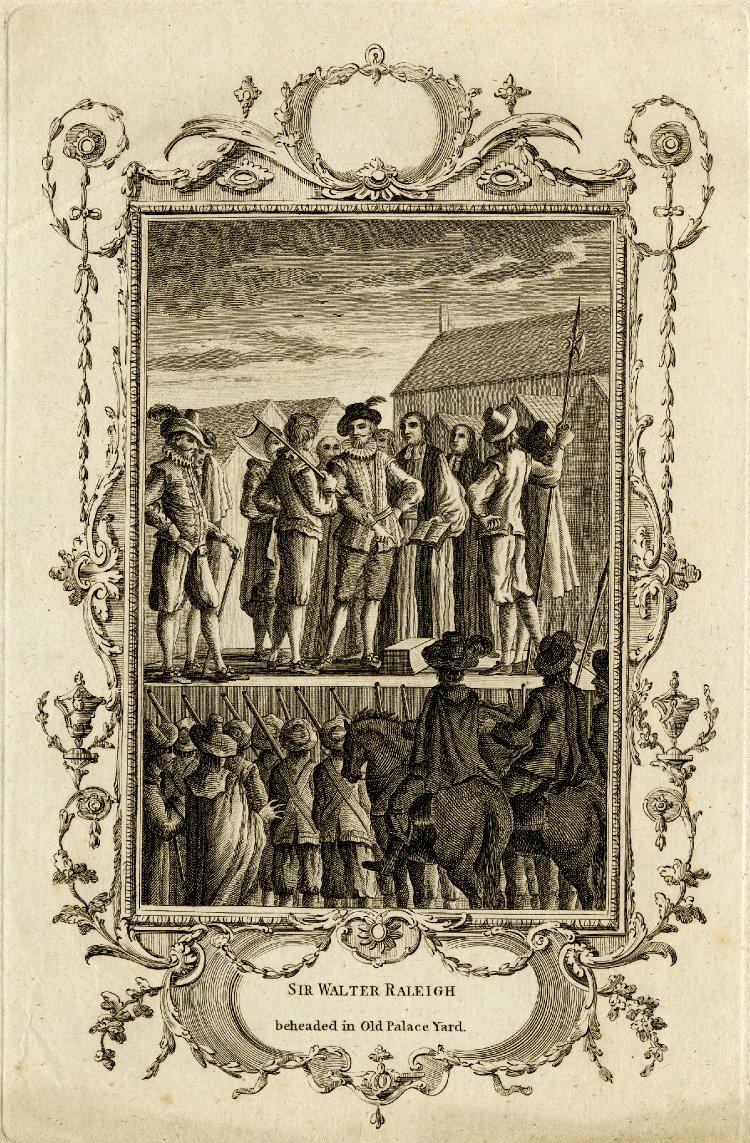


Sir Walter Raleigh, moments before his beheading in Old Palace Yard, Westminster. British Museum Collection

Following Raleigh’s execution, the Stuart government desperately tried to justify its action. In an attempt to ‘bury bad news’ it had arranged for the execution on 29 October 1618 in London to take place on the Lord Mayor’s Day, the timing being contrived ‘that the Pageants and fine Shows might avocate and draw away the people from beholding the Tragedie of the gallantest Worthie that England ever bred’, as the 17th century chronicler John Aubrey put it.


A further move by the government was the publication of a 68-page pamphlet justifying the execution.The full title was A/ Declaration/ of the Demea/nor and Cariage of/ Sir Walter Raleigh,/ Knight, as well in his Voyage, as/ in, and sithence his Returne;/ And of the true motiues and ìnduce/ments which occasioned His Maiestie/to Proceed in doing lustice upon him,/ as hath bene done. 


My irreverent take on Bacon, which I hope would have pleased Sir Walter 

The Lord Chancellor, Francis Bacon, later to be disgraced and charged with 23 separate counts of corruption, was the pamphlet’s principal author, working with the King. In a letter to a friend he wrote: ‘We have put the Declaration touching Raleigh to press, with his Majesty’s additions which were very material and fit to proceed from his Majesty.’


The title page of the 1620 pamphlet Raleigh’s Ghost. Manuscript at Trinity College Dublin

The Declaration was no doubt countered by less professionally produced publications which gave the opposite view. One of them,  ‘Vox Spiritus or Sir Walter Raleigh’s Ghost’, pictured above, was a handwritten pamphlet, conserved at Trinity College Dublin. It was produced in 1620 to promote the ideals of the late Sir Walter, namely the mistrust of Catholicism and all things Spanish. After Raleigh's execution in 1618 the King of Spain, the Pope and the Devil were seen as conspirators in a new version of the 1605 Gunpowder Plot.

In 1603, when Sir Walter Raleigh was first confined in the Tower, his violent and haughty temper had rendered him ‘the most unpopular man in England’ wrote the 18th century historian and philosopher David Hume. Fifteen years later, thanks due in part no doubt to the spread of such hispanophobic literature, the same writer stated: ‘No measure of James's reign was attended with more public dissatisfaction than the punishment of Sir Walter Raleigh.’


Pipe-makers, as well as pamphleteers, played their part in the defence of Sir Walter. In a fascinating blog post arising from the discovery of what was likely to be a 17th century clay pipe at Bermondsey, in the mud of the London Thames foreshore,  Natalie Cohen explains the significance of what were known as Sir Walter Raleigh pipes, such as the ones seen here.


Representing a bearded man being swallowed by a crocodile, the pipe is apparently based on the legend that Raleigh fell overboard during one of his expeditions and was seized by the creature which promptly let him go because it found the smell of smoke so unpleasant. Many such pipes were made in Holland during the 1630s and 1640s.

Why Holland?


It seems that James I imposed harsh restrictions on English pipemakers during his reign and many emigrated to Holland during the early 17th century, explains Natalie Cohen.  The number of English pipemakers in the Netherlands rivalled England by the third decade of the 17th century. ‘The Raleigh pipes were made as a memorial to the great smoker, with James I represented as the sea monster or snake “who swallowed Tudor power”’.


Photo of Ashburton Exeter Inn and Raleigh mural taken by John Stickland 26 Oct 2012. Not quite accurate as Sir Walter is seen smoking a cigarette rather than a pipe 

The full blog post ‘Walter Raleigh and the Crocodile – the Story of an Artefact’, including the above fascinating images can be found at http://www.thamesdiscovery.org/frog-blog/walter-raleigh-and-the-crocodile
Natalie Cohen’s blog refers to an article by Diane Dallal in Smoking and Culture: The Archaeology of Tobacco Pipes in Eastern North America, edited by Sean Michael Rafferty, Rob Mann  University of Tennessee Press, Knoxville 2004. Whales as well as crocodiles are part of Raleigh mythology!


I’m sure that Charlotte Coles will refer to this kind of curiosity in her talk to Lympstone History Society, ‘The History of Clay Pipes’, on Thursday 22 February 2018. 


The significance of personalised pipes, made in Jamestown, Virginia, in the early 17th century, is the subject of an article in National Geographic News, 30 November 2010  https://news.nationalgeographic.com/news/2010/11/101129-jamestown-personalized-pipes-virginia-history-colonial-america/

FOR THE RALEIGH 400  CALENDAR OF 
EVENTS WORLDWIDE
IN 2018 CLICK ON 
http://raleigh400.blogspot.co.uk/2018/01/raleigh-400-calendar-of-events-in-2018.html

Tuesday, 16 January 2018

Did smoking kill Sir Walter Raleigh?


Just in case some of you noticed the title of this post, the same title that heads the document in the photo of the museum case with its clay pipes, you may well have been wondering whether history got it wrong. Was Sir Walter indeed a victim of the tobacco that he loved so much rather than of the executioner’s axe?


Diego Sarmiento de Acuña, Count of Gondomar. Wikipedia

Of course Raleigh was killed on the orders of James I. The King had shamefully yielded to pressure from the Spanish ambassador. Unlike Queen Elizabeth, James had never taken to Sir Walter. “I have heard rawly of thee,” he is supposed to have said when the two men met after the Queen’s death.

There were many reasons for that. Sir Walter had been the favourite of the monarch responsible for executing King James’ mother, Mary Queen of Scots. It’s unlikely that the new king would have taken to him on those grounds alone.

In any case, Raleigh’s character had been thoroughly blackened, well before Queen Elizabeth I’s death, by devious politicians keen to be in favour with the new monarch and distance themselves from his predecessor.  


Robert Cecil, 1st Earl of Salisbury by John De Critz the Elder in 1602. National Portrait Gallery

This is clear from the publication in 1766 of a volume entitled The Secret Correspondence of Sir Robert Cecil with James VI, King of Scotland. It reveals that from May 1602 Raleigh’s supposed friend Secretary of State Sir Robert Cecil had been secretly corresponding with James I’s agents in Scotland, taking the opportunity of blackening Sir Walter’s character with accusations of atheism. Raleigh was, wrote Cecil in a letter that he knew James would read, a person 'whom most religious men do hold anathema'.


King James I of England and VI of Scotland, c.1606, after John De Critz the Elder. National Portrait Gallery

When James wrote his anti-smoking tract A Counterblaste to Tobacco in 1604, a year after his coronation as King of England and Scotland, he probably had Raleigh in mind as a target.  Sir Walter’s enjoyment of tobacco was well known at court, as much as his supposed atheism.


The title page of James I's Counterblaste to Tobacco, published anonymously in 1604

In attacking smokers who had yielded to the ‘corrupted basenesse’ of the weed, the King was hinting at the dissolute and corrupt nature of men like Raleigh.  

Smoking, wrote James, was “A custome lothsome to the eye, hatefull to the Nose, harmefull to the braine, dangerous to the Lungs, and in the blacke stinking fume thereof, neerest resembling the horrible Stigian smoke of the pit that is bottomelesse.”

There were various reasons for King James’ attack on tobacco smoking, and not all of them were prompted by care for the health of his subjects. 

At the beginning of his reign the King was annoyed that the Crown derived no financial benefit from tobacco use but this soon changed with the growth of tobacco   

‘It is ironic that James VI and I, who proclaimed his hatred of smoking in the Counterblaste of 1604, presided over the period in which tobacco became institutionalised in Britain and her New World colonies,’ observed historian Dr Anthony Rowley*. 

‘When the king assumed direct royal control over the Virginia colony and its tobacco in 1624, the misocapnic (smoke-hating) monarch became the greatest tobacco overlord the world had ever seen.’

I just had to copy that word ‘misocapnic’.

So King James wasn’t quite the modern thinker that the anti-smoking lobby would have us believe.


Native American Indians performing a ritual dance.  Watercolour by John White.   British Museum 

On various occasions in the Counterblaste he blames the indigenous peoples of the New World for the ills associated with tobacco smoking, hinting that they are an inferior and dissolute race – a ‘barbarous people’ – riddled with venereal disease.

The ‘vile and stinking’ custom has been introduced into Europe, he claims, in imitation of the ‘barbarous and beastly maners of the wilde, godlesse, and slavish Indians.’ The custom of smoking originated in the Americas because, in the King’s words, 'tobacco was first found out by some of the barbarous Indians, to be a Preservative, or Antidot against the Pockes, a filthy disease, whereunto these barbarous people are (as all men know) very much subject, what through the uncleanly and adust constitution of their bodies, and what through the intemperate heate of their Climat.’

This is a portrayal of native inhabitants of the New World very different from the one revealed by Raleigh’s friend Thomas Hariot.  He along with the artist and mapmaker John White, was part of an expedition to Roanoke Island in the mid-1580s. 

John White himself, judging by the celebrated watercolours of Native American life that he made, has been admired for the way in which he portrayed the 'gentle and proud' indigenous peoples of the New World. ‘Come to this place where everything is neat and tidy and there is food everywhere!’ is the message of John White’s watercolours according to the American author and science historian Deborah Harkness. For more on this theme see https://raleigh400.blogspot.co.uk/2017/12/raleighs-new-world-hunting-sir-walter.html


Detail from the title page of Thomas Hariot’s A Briefe and True Report of the New Found Land of Virginia, 1588

With a genuine interest in the language and customs of the Algonquian Indians Hariot was evidently impressed by those that he met judging by his account. 


North Carolina Algonquins eating. Engraving by Theodor de Bry after a watercolour painted by John White

In their diet, for example, he describes how Native Americans are ‘moderate in their eating whereby they avoid sickness,’ and how they are ‘consequently very long lived because they do not oppress nature.’   


Republic of Guyana, 100 Dollar Gold Coin 1976. Commemorating the book Discovery of Guiana 1596, and 10 Years of Independence from British Rule.

As for Sir Walter himself, only in 1595 did he set foot in the New World with the expedition that he led to the Orinoco region of modern day Venezuela. His description of the indigenous population is even more explicit in its praise of people whom the king would have derided as ‘beastly Indians’.  

‘I never beheld a more goodly or better favoured people, or a more manly,’ he wrote in his Discoverie of Guiana, published in 1596, just four years before James’ Counterblaste. Naturally, of course, his positive depiction of the New World and its peoples was intended partly to encourage English investment in his colonizing schemes.  

For King James, it seems, the peoples of the New World who had impressed Raleigh and his friends were not just diseased but primitive, unsophisticated devil-worshippers. ‘Why doe we not as well imitate them in walking naked as they doe?’ he asks sarcastically. ‘in preferring glasses, feathers, and such toyes, to golde and precious stones, as they do? yea why do we not denie God and adore the Devill, as they doe?’

It’s clear that in scornfully demonising the peoples of the New World James was also attacking Raleigh, a court favourite of the previous regime. 

But with his vituperative racist slurs in the 1604 Counterblaste some historians have seen the King as contributing significantly to a tragic relationship between European settlers and American Indians which would result in what has been widely described as genocide.

Why such vituperation?


Vignette portrait of George Chapman from frontispiece to his Whole works of Homer  
Photo British Museum; engraving W. Hole, 1616  

There had of course been much negative portrayal of Scotland and the Scots in the centuries preceding the Union of 1603 when James VI was crowned as James I of England. Many anti-unionists held racist views of the Scots as barbaric and primitive, and King James would have been well aware of this. 

In 1605 a performance of the comedy Eastward Ho! with its anti-Scottish satire resulted in the imprisonment of the play’s authors George Chapman and Ben Jonson. Perhaps King James’ Counterblaste was written partly in the hope of deflecting such anti-Scottish racist slurs by focusing attention on tobacco smoking, the ‘vile custome’ of the ‘beastly Indians’ who were, in his opinion, the true 'barbarous people'.      


An 1860s artist’s impression of the execution of Sir Walter Raleigh. Included in The Popular History of England: An Illustrated History of Society and Government from the Earliest Period to Our Own Times, by Charles Knight 


No, smoking did not kill Sir Walter. Queen Elizabeth’s favourite was certainly executed on the orders of her successor for reasons of state. But Raleigh’s reputation as a smoker would not have helped his case.  

* How England learned to smoke: the introduction, spread and establishment of tobacco pipe smoking before 1640 
PhD thesis, University of York, 2003, Anthony R. Rowley 
http://etheses.whiterose.ac.uk/9845/1/403870.pdf

Continued at http://raleigh400.blogspot.co.uk/2018/01/of-pamphlets-and-pipes.html


FOR THE RALEIGH 400  CALENDAR OF 
EVENTS WORLDWIDE
IN 2018 CLICK ON 
http://raleigh400.blogspot.co.uk/2018/01/raleigh-400-calendar-of-events-in-2018.html

Monday, 8 January 2018

A Clay Pipes Talk in Lympstone


Clay pipes? Maybe not a subject that fires up many people, especially in an anti-smoking age, but in this year of Sir Walter’s anniversary I’m finding many areas where my interest is unexpectedly sparked.  


It seems only right to publicise Charlotte Coles’ talk especially as I recall a corner of our Fairlynch Museum exhibition, showing some of our rather fine clay pipes, where the question is asked: ‘Did smoking kill Sir Walter Ralegh?’

Charlotte is an osteoarchaeologist who has been working in commercial archaeology for 10 years. She a master’s degree in Osteoarchaeology from Bournemouth University and carries out animal and human bone analysis as well as archiving and reporting on finds, working on a freelance basis for a variety of employers including Exeter City Council.  


The talk is presented by Lympstone History Society on Thursday 22 February at 7.30 pm in the Methodist Hall, Chapel Road in Lympstone. Entry is £3.50 for members or £4.00 for non-members, with refreshments included. Smokers and non-smokers welcome! 

If this theme interests you click on  https://raleigh400.blogspot.co.uk/2018/01/did-smoking-kill-sir-walter-raleigh.html


FOR THE RALEIGH 400  CALENDAR OF 
EVENTS WORLDWIDE
IN 2018 CLICK ON 

http://raleigh400.blogspot.co.uk/2018/01/raleigh-400-calendar-of-events-in-2018.html

Raleigh the Peacemaker (1586)

  A copy, in All Saints' Church East Budleigh, of one of the best known portraits of Sir Walter formerly attributed to Zuccaro but now...