Showing posts with label tobacco. Show all posts

Tuesday, 6 November 2018

Sir Walter unveiled: 7 February 2006


The statue of Sir Walter Raleigh wearing a very long cloak indeed


The statue of Sir Walter Raleigh was unveiled by HRH the Duke of Kent in 2006 and occupies a focal point in the Great Elizabethan’s home village near All Saints Church. Its origin was not without controversy.


(l-r):  HRH The Duke of Kent, Steve Baker, who was chairman of East Budleigh Parish Council, Hugo Swire MP, sculptor Vivien Mallock  


East Budleigh residents had hoped that an earlier statue of Sir Walter, originally sited on Whitehall Green, would be relocated to their village.


Sir Walter, taller than most men, then and now

They were disappointed when it was moved instead to the former Royal Naval College in Greenwich.


Sir Walter unveiled


Then local MP Hugo Swire stepped in to secure £30,000 in funding from British American Tobacco to ensure that the village would have its own statue.


Hugo Swire MP and Cllr Christine Channon

There were strong objections from some locals to the source of the cash, given the growth of the anti-smoking lobby in recent times. But the MP was unabashed. "If there are any objections to this from people who think we shouldn’t do this because its sponsored by British American Tobacco, I think I shall emigrate,” he was reported as saying.


"I cannot believe that there can be people around who would be so churlish and politically correct to assume because we’ve got sponsorship from a major international company we should somehow turn it down. I just would despair at that point. We want the statue, they’ve been hugely generous - thank you, thank you, thank you."


Sir Walter Raleigh on Independence Day

The Great Elizabethan was highly regarded in the USA. The American Navy named a warship after him in 1776.   

During the American War of Independence one of the 13 ships in the Patriots’ Navy was named USS Raleigh, a move which must have riled the British government.  


The seal of the American state of New Hampshire shows the USS Raleigh.


Above: Hayes Barton Baptist Church

Not only did the Americans name the capital of North Carolina after East Budleigh’s most famous son: the city of Raleigh NC has two districts named in the 1920s to honour Sir Walter. One is called Hayes Barton, the other is called Budleigh.  

Both districts are rather exclusive!


The face of a hero as created by Vivien Mallock FRBS
This maquette was kindly lent by the sculptor in 2015 for display in Fairlynch Museum’s Sir Walter Ralegh Room 

Whatever the controversial element of the statue’s funding, the sculptor has positive memories of the commission.

'I recall with great pleasure the commission to sculpt Sir Walter in East Budleigh, and the enthusiasm for him shown by all those who attended the unveiling,’ Vivien Mallock told me earlier this year.

I am most grateful to Cllr Channon for making photos of the unveiling available to me. 


FOR THE RALEIGH 400  CALENDAR OF 


 .

Tuesday, 28 August 2018

When the gloves were off for Raleigh


Image courtesy of Dents Museum

This pair of beautifully decorated gloves associated with Sir Walter Raleigh is among the highlights of Fairlynch’s exhibition to mark the 400th anniversary of the Elizabethan explorer’s death.

Described as ‘off-white doeskin, embroidered with gold and silver metal threads, tiny “spangles” and edged with silver gilt fringing’, the gloves have been dated as made in about 1600.  They are on loan from Dents Collection, based at the centuries-old Warminster-based firm of glovemakers.

Highly decorative gloves were a demonstrable sign of status and wealth, often given as gifts as a reward for service or supplication for expected favours. These gloves were not for wearing – hence their survival in such good condition.

‘There were few tokens of bonding and friendship that were as important in early modern culture,’ writes Felicity Heal in her 2014 book The Power of Gifts: Gift Exchange in Early Modern England. ‘The hand gesture as a mark of amity made these relatively simple gifts rich in symbolic power.’


Image of Bess, Lady Raleigh, as featured at Fairlynch Museum  
It was around 1600 that Raleigh’s wife Bess had made gloves for Sir Robert Cecil, Queen Elizabeth’s Secretary of State. 

One of the most powerful and the most calculating politicians of the time, he was a man whom both she and Walter regarded as their friend. In a letter to Cecil at this time Raleigh wrote that Bess ‘says that she must envy any fingers whosoever that shall wear her gloves but your own.’


Sir Robert Cecil, created 1st Earl of Salisbury by King James I    Image credit: National Portrait Gallery

What neither Bess nor Walter realised was that their supposed friend was actively engaged in their destruction. The Tudor dynasty was nearing its end, to be succeeded by the House of Stuart. 

Aware that the most likely successor to the increasingly frail Queen would be the King James VI of Scotland, Cecil was making plans for a transfer of power in which Raleigh would be sacrificed.  

It was important, he saw, that the character of the old Queen’s favourite be blackened in the eyes of the Scottish king so that Cecil would be seen as a supporter of the new regime.


King James I of England and VI of Scotland, c.1606, after John De Critz the Elder (c.1551-1642) National Portrait Gallery

Raleigh’s reputation as a smoker was bad enough to inspire the Scot’s disgust at such a habit. Sir Walter’s enjoyment of tobacco was well known at court. More serious for him was his reputation as an atheist, and it was this that Cecil used to encourage James’ mistrust of Raleigh. 

Since the beginning of May 1602 the Secretary of State had been engaged in a treasonable correspondence with James’ ministers in Scotland, using a secret code of numbers. The Queen was 24, James was 30, Raleigh was 2. Cecil himself was 10. 

It was in a letter of this time that Cecil wrote to King James about his supposed friend that he was a person ‘whom most religious men do hold anathema’. The underhand accusation was, as described by Sir Walter’s biographer Raleigh Trevelyan, a ‘stunningly disloyal’ act.   


St Mary’s Church, Cerne Abbas
Image credit: Chris Downer

It was true that Sir Walter, a relatively freethinking man for his age, had been accused of atheism. A commission had been set up in 1594 at Cerne Abbas, close to his home at Sherborne Castle, to deal with accusations that Raleigh and his circle of intellectuals, known to some as ‘The School of Night’, had denied the reality of heaven and hell.  He was acquitted, but the accusation of atheism was again raised at his trial for treason in 1603. 

It is likely that this contributed to the guilty verdict reached by the court, a verdict which would prove fatal after the failed 1617 expedition to Guiana.


Rosemary Harden supervises the installation of the gloves in the Raleigh 400 display, with Fairlynch Museum Trustee Martyn Brown. Rosemary, curator of the Fashion Museum in Bath, worked with Dents Collection on the Museum's loan request for the gloves  

These gloves are fabulous. You can imagine Bess Raleigh’s hands at work as she gives the finishing touches to a similar pair destined for the hands of her husband’s supposed friend Robert Cecil. 


Maybe this is at a time when Bess and Walter are caring for Cecil’s young son Will at Sherborne Castle.  The boy’s mother, Elizabeth Cecil had died in childbirth, aged only 34. Walter has poured his deepest and most poignant reflections into a letter to Robert Cecil dated 24 January 1597, written to console the distraught widower. 

But you can also reflect on the thoughts that cross Bess’ mind as she wonders how far she and Walter can trust him. Perhaps you can imagine the gloves discarded; those clever hands and fingers will be at work within just a few years on a treasonable correspondence with a foreign king. It will ultimately take Walter to the scaffold.   


FOR THE RALEIGH 400  CALENDAR OF 


Sunday, 28 January 2018

Of Pamphlets and Pipes


King James I of England and VI of Scotland, c.1606, after John De Critz the Elder (c.1551-1642) National Portrait Gallery

In a previous post I painted King James I in a rather villainous light, pointing out his clearly racist view of New World peoples and hinting that such an attitude, coupled with his hatred of smokers, may have contributed to the decision to execute Sir Walter Raleigh.  


17th century smokers, an illustration from 
E.R. Billings - Tobacco: its history, varieties, culture, manufacture and commerce, with an account of its various modes of use, from its first discovery until now. Hartford, Conn. 1875

It seems that 17th century smokers did not take long to hit back, avenging their hero’s death.


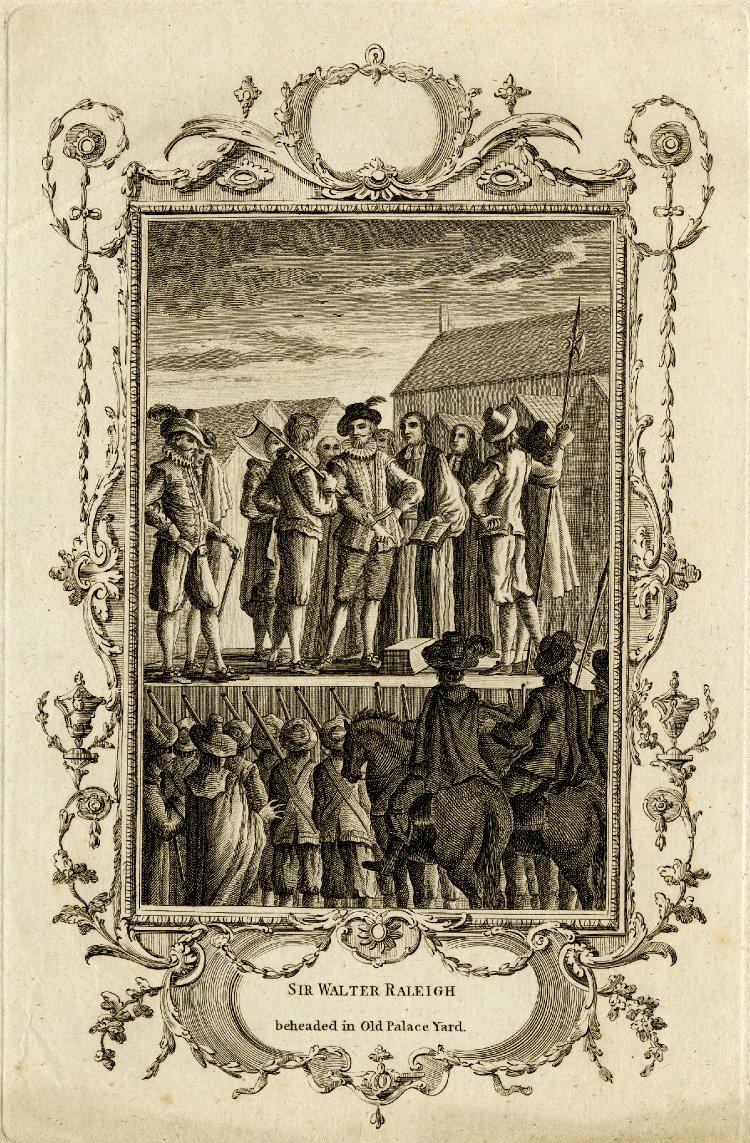
Sir Walter Raleigh, moments before his beheading in Old Palace Yard, Westminster. British Museum Collection

Following Raleigh’s execution, the Stuart government desperately tried to justify its action. In an attempt to ‘bury bad news’ it had arranged for the execution on 29 October 1618 in London to take place on the Lord Mayor’s Day, the timing being contrived ‘that the Pageants and fine Shows might avocate and draw away the people from beholding the Tragedie of the gallantest Worthie that England ever bred’, as the 17th century chronicler John Aubrey put it.


A further move by the government was the publication of a 68-page pamphlet justifying the execution.The full title was A/ Declaration/ of the Demea/nor and Cariage of/ Sir Walter Raleigh,/ Knight, as well in his Voyage, as/ in, and sithence his Returne;/ And of the true motiues and ìnduce/ments which occasioned His Maiestie/to Proceed in doing lustice upon him,/ as hath bene done. 


My irreverent take on Bacon, which I hope would have pleased Sir Walter 

The Lord Chancellor, Francis Bacon, later to be disgraced and charged with 23 separate counts of corruption, was the pamphlet’s principal author, working with the King. In a letter to a friend he wrote: ‘We have put the Declaration touching Raleigh to press, with his Majesty’s additions which were very material and fit to proceed from his Majesty.’


The title page of the 1620 pamphlet Raleigh’s Ghost. Manuscript at Trinity College Dublin

The Declaration was no doubt countered by less professionally produced publications which gave the opposite view. One of them,  ‘Vox Spiritus or Sir Walter Raleigh’s Ghost’, pictured above, was a handwritten pamphlet, conserved at Trinity College Dublin. It was produced in 1620 to promote the ideals of the late Sir Walter, namely the mistrust of Catholicism and all things Spanish. After Raleigh's execution in 1618 the King of Spain, the Pope and the Devil were seen as conspirators in a new version of the 1605 Gunpowder Plot.

In 1603, when Sir Walter Raleigh was first confined in the Tower, his violent and haughty temper had rendered him ‘the most unpopular man in England’ wrote the 18th century historian and philosopher David Hume. Fifteen years later, thanks due in part no doubt to the spread of such hispanophobic literature, the same writer stated: ‘No measure of James's reign was attended with more public dissatisfaction than the punishment of Sir Walter Raleigh.’


Pipe-makers, as well as pamphleteers, played their part in the defence of Sir Walter. In a fascinating blog post arising from the discovery of what was likely to be a 17th century clay pipe at Bermondsey, in the mud of the London Thames foreshore,  Natalie Cohen explains the significance of what were known as Sir Walter Raleigh pipes, such as the ones seen here.


Representing a bearded man being swallowed by a crocodile, the pipe is apparently based on the legend that Raleigh fell overboard during one of his expeditions and was seized by the creature which promptly let him go because it found the smell of smoke so unpleasant. Many such pipes were made in Holland during the 1630s and 1640s.

Why Holland?


It seems that James I imposed harsh restrictions on English pipemakers during his reign and many emigrated to Holland during the early 17th century, explains Natalie Cohen.  The number of English pipemakers in the Netherlands rivalled England by the third decade of the 17th century. ‘The Raleigh pipes were made as a memorial to the great smoker, with James I represented as the sea monster or snake “who swallowed Tudor power”’.


Photo of Ashburton Exeter Inn and Raleigh mural taken by John Stickland 26 Oct 2012. Not quite accurate as Sir Walter is seen smoking a cigarette rather than a pipe 

The full blog post ‘Walter Raleigh and the Crocodile – the Story of an Artefact’, including the above fascinating images can be found at http://www.thamesdiscovery.org/frog-blog/walter-raleigh-and-the-crocodile
Natalie Cohen’s blog refers to an article by Diane Dallal in Smoking and Culture: The Archaeology of Tobacco Pipes in Eastern North America, edited by Sean Michael Rafferty, Rob Mann  University of Tennessee Press, Knoxville 2004. Whales as well as crocodiles are part of Raleigh mythology!


I’m sure that Charlotte Coles will refer to this kind of curiosity in her talk to Lympstone History Society, ‘The History of Clay Pipes’, on Thursday 22 February 2018. 


The significance of personalised pipes, made in Jamestown, Virginia, in the early 17th century, is the subject of an article in National Geographic News, 30 November 2010  https://news.nationalgeographic.com/news/2010/11/101129-jamestown-personalized-pipes-virginia-history-colonial-america/

FOR THE RALEIGH 400  CALENDAR OF 
EVENTS WORLDWIDE
IN 2018 CLICK ON 
http://raleigh400.blogspot.co.uk/2018/01/raleigh-400-calendar-of-events-in-2018.html

Raleigh the Peacemaker (1586)

  A copy, in All Saints' Church East Budleigh, of one of the best known portraits of Sir Walter formerly attributed to Zuccaro but now...