
All John White images © The British Museum
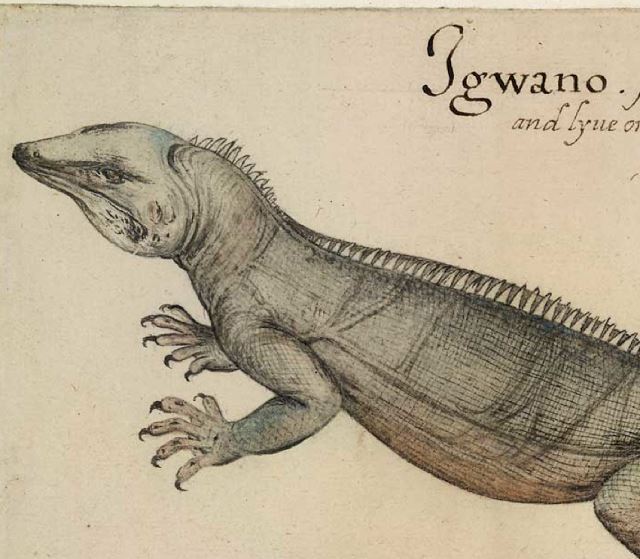
A talk about Sir Walter Raleigh – and I did quite a few in 2018 – covers so many aspects! One that’s always interesting for audiences because of the visual element – as opposed to the talking – is the amazing collection of watercolours by John White, one of the treasures of the British Museum.
 The paintings are a record of White’s time as
an artist and mapmaker on the 1585 expedition to Roanoke Island, on the east coast of North America, funded by Sir Walter Raleigh.
The paintings are a record of White’s time as
an artist and mapmaker on the 1585 expedition to Roanoke Island, on the east coast of North America, funded by Sir Walter Raleigh.
Also accompanying the expedition was Raleigh’s friend and tutor, the scientist Thomas Harriot.
His account of the voyage, named 'A Briefe and True Report of the New Found Land of Virginia', was published in 1588, probably written a year before.
His account of the voyage, named 'A Briefe and True Report of the New Found Land of Virginia', was published in 1588, probably written a year before.
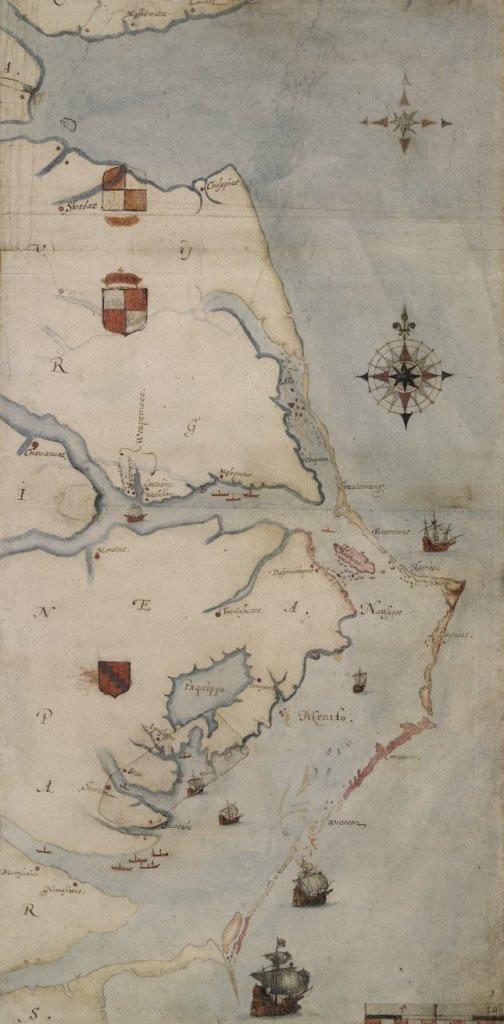
Above: Virginea Pars map, drawn by John White during his initial visit in 1585. Roanoke is the small pink island in the middle right of the map.
White’s images were used by the publisher Theodor de Bry in a new, illustrated 1590 edition of 'A Briefe and True Report of the New Found Land of Virginia'. They added to an already intense interest in the New World.
The only surviving visual record of the land and peoples encountered by England’s first settlers in America, the paintings are rarely on display, needing to be kept away from the damaging effects of light. A major public of the images took them to the USA in 2008.
The British Museum had no plans to exhibit them for Raleigh’s 400th anniversary.

A watercolour by John White depicting a village of the Secotan Indians in North Carolina
‘Come to this place where everything is neat and tidy and there is food everywhere!’ is the message of John White’s watercolours according to the American author and science historian Deborah Harkness.

'The towne of Pomeiock and true forme of their houses, covered and enclosed some wth matts, and some wth barcks of trees'

'The manner of their fishing'




'You won't starve' in the New World' is the message that Raleigh was keen for readers to understand.


'The seething [boiling] of their meate in Potts of earth'

Equipment for curing fish used by the North Carolina Algonquins


Dancing Secotan Indians on Roanoke Island

A ceremony of Secotan warriors

An Algonquian chief


A 'flyer' or medicine man


Apart from his achievement as a an artist, John White is known as the grandfather of Virginia Dare, the first English-speaking child to be born in the New World. Tragically, he never saw his granddaughter, who was one of the 115 settlers known as 'The Lost Colony'

Governor John White and his men discover in 1590 the word CROATOAN carved on a tree - the only trace of the 1587 ‘Lost Colony’ of 115 settlers which included White's granddaughter (19th century illustration)
The later history of the relationship between
Native Americans and the English is an unhappy one, full of sad episodes of
mistrust, betrayal, violence and murders in which two of Raleigh’s commanders,
Sir Richard Grenville and Sir Ralph Lane, played critical roles.
John
White was different, wrote David Stick in his book 'Roanoke Island: The
Beginnings of English America'(1983). He was ‘without
question, a compassionate man, and, unlike Lane, an individual with a reverence
for all God’s earthly creations, including even the natives of America, whom he
had depicted in his drawings as people both gentle and proud.’
Historian Anna Beer, while writing of what she
described as ‘the dark underbelly of the English colonial project’, cites John
White’s drawings and Thomas Harriot’s study of the Algonquin language as
supporting the view of those who argue that Raleigh ‘respected the culture and
people he was intruding on, and sought to understand it and them’.
Had Raleigh himself led the 1585
Roanoke expedition rather than Grenville and Lane, things might have taken a
happier turn. But that’s wishful thinking. Queen Elizabeth kept her favourite
at court. And however ‘soft’ Raleigh’s imperialism may have been, English
culture would end up by first transforming and then obliterating the culture of
Native America as Dr Beer points out.
Yet John White’s drawings can
stand on their own, be admired, and allow us to dream of how it might have
been.

FOR THE RALEIGH 400 CALENDAR OF
EVENTS WORLDWIDE
IN 2018 CLICK ON


